
Compass AI

Tech4Good Lab
PROJECT OVERVIEW
Compass is an AI-supported mentorship platform designed to help students reflect, share experiences, and receive guidance. It structures large-group conversations into clear, meaningful interactions that support connection, engagement, and personalized mentorship.
GOAL
Redesign a conversational mentorship experience that remains personal and coherent, even when supporting many students at once based on the original iteration of Compass, in which generative AI was not used.
PROBLEM
Meaningful mentorship within academic settings is often difficult to find, especially at scale. Large-group mentorship is challenging to facilitate in person and even harder to translate into an online environment, where conversations can fragment, messages are easily lost, and students struggle to feel heard.
Role
Team Lead
UI/UX Research
UI/UX Design
Timeline
Jan 2024
6 Months
Tools
Figma
Skills
Wireframing & Prototyping
Leadership
DISCOVER
Understanding the Foundations
Because this project was an extension of the published work Compass: Supporting Large Group Mentorship in a Chat-Based UI, it was essential for me to begin by grounding myself in the core concepts of the original system. The paper introduced Compass as a platform designed to help industry professionals mentor over 30 mentees at once—encouraging equal participation, reducing noise and disorganization in group chats, and creating a more coherent structure for large-scale mentorship.
A key innovation in the original design was the use of multi-person conversational units—structured moments that condense many related messages into a single, digestible interaction. These units maintain coherence in fast-moving discussions and allow mentors to manage high message volume without losing the human connection at the center of mentorship.
Learning UX and Conversational Systems
Since Compass was my first experience with UI/UX research and design, this phase also served as my introduction to foundational design principles. I focused on understanding how interface choices shape clarity, pacing, emotional tone, and the overall experience of online mentorship. Studying the original system helped me identify the constraints and opportunities of designing for chat-based environments, especially those involving large groups.
Studying the Existing Compass Model
To understand how Compass creates meaningful conversation at scale, I analyzed how the system organizes dialogue, how prompts guide participation, and how summaries stabilize the flow when many students are interacting at once. Examining structured prompts, grouping mechanisms, and threaded expansions helped me see how large cohorts can stay engaged without overwhelming the interface—and clarified the design considerations I would build upon in the next stages of the project.
Team Leadership Context
I served as the team lead for our four person UI/UX team. Because the project did not have a PhD lead like most teams within our lab, I was responsible for guiding our direction, coordinating design discussions, and ensuring consistency across iterations. I organized weekly work sessions, clarified goals and next steps, and ensured proper participation/attendance.
DESIGN
Lo-Fi Wireframing and Early Concept Exploration
Wireframing was an essential learning stage. I began with broad pencil and paper sketches to understand how messages, clusters, and prompts might interact on the screen. This was also my chance to understand the design process and iterating


After initial sketches we transitioned to using Figma for more detailed prototyping. I created simple prototypes that helped me get comfortable with the tool while testing foundational layout ideas.
My early concepts included:
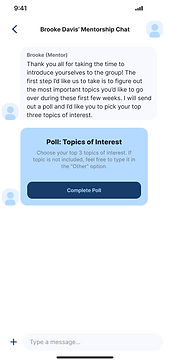
• a basic chat layout where AI provides gentle structure and guidance
• poll and response models to support collaborative reflection
• variations of AI-assisted clustering, exploring how the system might surface themes or reduce noise
• early navigation models for browsing multiple topics within a single conversation
These sketches raised important design questions about the role of AI:
What should feel automated? What should remain human? How can AI assist without feeling intrusive?




Iterative Structure Exploration
As I grew more comfortable with Figma, I created multiple sets of low-fidelity wireframes to test:
• how prompts appear and evolve
• how users scroll through long conversations
• how clusters and summaries should be visually represented
• different ways for mentors to navigate overlapping messages
• transitions between high-level summaries and detailed views
Each iteration helped uncover usability challenges and refine the overall structure before moving into high-fidelity design.


DEVELOP
Transitioning to Higher Fidelity Designs
After iterating on low-fidelity wireframes, we moved into more detailed high-fidelity versions that more clearly mapped out the platform’s functionality. At this stage, I began designing specifically from the mentor’s perspective, since mentors face the greatest cognitive load in large-group conversations.
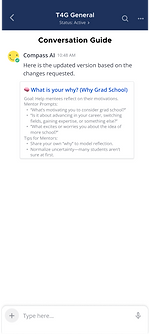
One of the core features I explored was a Conversation Guide. This tool helps mentors collect and organize questions from the main chat so they aren’t lost as the discussion moves forward. The guide works by:
• allowing mentors to bookmark questions they want to revisit later
• using AI to generate an organized guide based on the conversation landscape
• grouping related questions and topics together
• giving mentors the ability to edit, refine, and save the guide
This feature emerged from a key challenge we identified early on:
mentors often receive more questions than they can immediately address, and not every question fits into the current flow of conversation.
The Conversation Guide allows mentors to maintain control of pacing, prioritize topics, and respond more thoughtfully — all without losing sight of student needs or overwhelming the interface.
As I continued developing the high-fidelity screens, I focused on features that supported the same goals: clarity, structure, and a sense of connection, even when many messages are being shared at once.




Integrating AI as a Supportive Layer
Beyond organizing mentor workflows, we also explored how AI could enhance the mentee experience by creating a more personal, companion-like environment within the platform. One concept we prototyped was a dual-view interface inspired by social media patterns: a primary chat for real-time conversation, paired with a customizable feed where mentees could organize, revisit, and reflect on discussion topics.
In this model, AI acts as a gentle guide by:
• highlighting meaningful messages
• grouping related posts into themes
• surfacing questions or insights a mentee may have missed
• helping mentees build a sense of continuity and connection across sessions
The intention behind this design was to strengthen peer support and community-building, especially in settings where students may feel intimidated, overlooked, or disconnected in large-group conversations. By layering structure onto the chat experience, the feed becomes a personalized space where mentorship feels more approachable and collaborative — without losing the immediacy of real-time interaction.
This exploration helped us consider how AI can support not only clarity and organization, but also emotional presence and belonging in online mentorship environments.


DRAFT
Shaping the Conceptual Narrative
Alongside my design responsibilities, I also contributed to the written development of the next iteration of the Compass research paper. This work focused on clarifying the system’s purpose, grounding it in existing research, and articulating the conceptual frameworks that guide its design.
I helped draft a revised introduction that explained:
• why large-group mentorship is difficult to facilitate
• how conversational systems can support reflective learning
• what design principles the original Compass model was built on
• how our new design explorations extend or refine those ideas
This process required translating complex system behaviors into clear, accessible language that could communicate the project’s significance to both academic and industry audiences.
DIGEST
Insights
Compass taught me how complex and layered UX and UI design becomes when working within a conversational system that must support many users at once. Designing for large-scale dialogue required thinking beyond the interface, understanding pacing, cognitive load, emotional tone, and how structure shapes whether participants feel supported or overwhelmed. Through constant iteration, I learned how to break down ambiguity into solvable components, test assumptions early, and refine the system through cycles of feedback and exploration.
This project strengthened my ability to:
• translate abstract interaction concepts into clear design patterns
• use iteration to uncover usability challenges and refine clarity
• align visual decisions with research insights and user needs
• balance system structure with human connection
• design intentionally for both mentors and students in a shared environment
Working on Compass grounded my understanding of UX and UI as a process of continual inquiry, refinement, and meaning-making.
My Reflection
Compass was also the first project where I stepped into a leadership role, and this happened during my very first quarter in the lab. As a new member, I did not expect to take on substantial responsibility so quickly, but the absence of a PhD lead meant that I became the point person for guiding our four-person team. I structured our workflow, facilitated discussions, clarified design directions, and helped maintain momentum across iterations.
Taking on this level of responsibility early taught me how to navigate ambiguity, make decisions with limited precedent, and support teammates while learning in real time. Balancing leadership with being new to UX and UI pushed me to grow quickly and sharpened my ability to communicate clearly and act with intention.
More than anything, Compass showed me the kind of designer I want to become: someone who can lead thoughtfully, design with clarity, and build systems that support meaningful connection at scale.